Self-construction is the manifestation of coincidence between the Inhabitant and the Constructor – when he demonstrates by active participation in creating the significance of space. Thus, space becomes the vehicle of tensions, ambitions, needs, experiences, dissatisfactions, interests of a family unit (and only of it) and of its own dynamic relation with people and objects. It is possible therefore to create a form of communication which assumes the behavior as information, over and above the physical, technical and functional construction of the building, as with architecture.
– Exogenous actions on the urban dimension
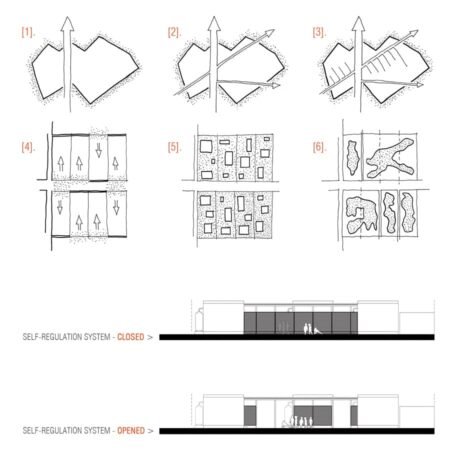
1. Draw up connection axes – for transport of people, data, energies, goods.
2. Measure the social habits which define the minimum units of common space.
3. Subdivide the minimum units of common space into the maximum units of private space.
– Endogeneous actions on the house dimension
4. Distinguish full from empty spaces.
5. Orient the maximum units of private space.
6. Establish the relationship between the units of private space.
Self-regulation of private space units denotes the relationship between the family unit and adjoining units. Self-regulation of the common space units denotes the relationship between the family unit and social habits. Self-regulation of social habits breaks (intentionally or not) urban dimension. The most elementary forms of social relationships connect to the joint production of symbolic values – even if the sponsors’ opinions may change the present (and therefore the future) prevalent cultural establishment. In relation to the family unit tradition is “regular doings”. In relation to the family unit innovation is adaptation.